Showing posts with label karma. Show all posts

Friday, February 09, 2007

Tethering the Monkey and Reining in the Horse

One of the books I’m reading now is Life After Death: The Burden of Proof by Deepak Chopra, which I finally managed to lay my hand on via a local public library loan after a substantial period of being on the waiting list. That by itself certainly attests to the popularity of the book.

This is the very first book by Deepak Chopra that I actually pore through its pages, a few pages a day. To him, life and death, which to some of us signifies the end of the road, is one continuous creative project. “At the end of our lives, we “cross over” into a new phase of the same soul journey we are on right this minute,” so says on the inside flap of the book cover. But there are caveats, which are reflected in his urgent message below, so continues the inside flap:

Who you meet in the afterlife and what you experience there reflect your present beliefs, expectations, and level of awareness. In the here and now you can shape what happens after you die.

So turns the giant karmic wheel of life, and afterlife. This is accountability at the most basic and individualistic level. Good karma comes from being good as in being virtuous, and vice versa. And bad deeds are only offset by good merits, but not written off, and accrue over a single lifetime.

Yesterday I reached the preamble to Chapter 5: The Path to Hell, which tells the story of a monkey who was kept captive in a small room in a castle tower, and who grew restless by the minutes.

At first, he was distracted by the view outside. Then his thoughts started to dwell on his predicament, raising questions why he was so confined. Failing to come out with any answer, his mood grew sombre. Claustrophobia set in. Perspiring profusely, the monkey felt like in a cauldron buried deep in a dungeon, the infernal fire striking up a hellish heat and demons imparting unbearable pain.

After what seemed like an eternity, the monkey grew accustomed to the ordeal and his mind started to drift to the fact that no one was bothering him and the realization that the view out there could be enjoyable too.

Encouraged by the seeming well-being, he started to harbor more positive thoughts as the demons spirited away. In time, he was so buoyed that he found himself ascending to, where else, paradise, pampered by doting angels.

Now the monkey thinks he is in eternal bliss, the diametrical opposite of abyssal hell, until he gets bored again, and you know where the story is headed, intones Deepak Chopra.

And yes, the parable has its human parallels: “The monkey is the mind, sitting alone in the tower of the head,” the book declares. Here I think is best not to paraphrase like what I’ve done above, but rather defer to the story teller that is Deepak Chopra:

As the mind expands with pleasure and contracts with pain, it creates every possible world, constantly falling for its own creations. The monkey will believe in heaven for a while, but then boredom will set in, and being the seed of discontent, boredom will pull him out of heaven and back down to hell.

So are we then caught in a perpetual flip-flop or roller coaster ride? The ever eloquent Deepak Chopra, by way of the character of Ramana, the ascetic monk, answers with an emphatic NO:

Only if you agree to be trapped. I didn’t say the tower was locked. There is an infinite domain outside the castle walls. You can take your mind beyond walls. There is freedom outside, and having achieved it, you will never have to go to heaven or hell again.”

That reminds me of a Chinese proverb that likens the heart to a monkey, and the mind, to a horse. The former is restless, swinging from tree to tree while the latter is galloping out of control. We need to tether the monkey and put a rein on the horse. And we will be able to see everything in a whole new light.

Thursday, November 16, 2006

Understanding Buddhism

On weekdays, I usually leave home at about five minutes after seven in the morning to send my daughter to school. That means I only watch about five minutes of the Today show on NBC, which starts at 7.00 am sharp.

So I know the Today show people have started a series called “The Mystery of Faith”, which started with Judaism, Christianity and Islam. Then yesterday morning, the focus turned to Eastern religions, and the show displayed some images of the religions that caught my attention, that of the Buddha. However, I could not stay on to watch because of a prior commitment as aforementioned.

So today after work I was able to watch the replay on NBC’s website, which consists of two 5-minute segments hosted by Campbell Brown and filmed in Hong Kong, now part of China.

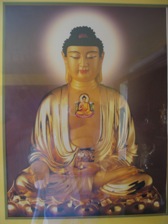
The first segment started with Ms. Brown standing in front of a gigantic sitting Buddha said to be 10 storey high, one of five such Buddha statues in China. Visitors have to climb 268 steps to reach the Buddha site, according to Ms. Brown.

In her narrative, she covered two eastern religions: Hinduism and Buddhism. On Hinduism, she said that the religion, which has over a billion followers, actually started in Pakistan about three thousands years ago and spread into India. The Buddha was born in India, and Buddhism spread from there into the Asian Continent. There are now about 375 millions Buddhist practitioners (read here for my choice of the term "practitioners") worldwide.

Both religions are not well understood by the West, perhaps sometimes overshadowed by the elaborate ritualistic practices, and apparent worship of multiple deities. Both are often viewed as a kind of enigma, with ornate temples/shrines and mysterious looking gods.

She correctly asserts that Buddhism is not an institutionalized religion, but rather a personal journey to enlightenment. Therefore, everyone has the divinity within each to become a Buddha.

Neither does Buddhism profess total renunciation of the present life, but rather one should actively pursue a meaningful life by helping others, by doing good deeds, and by repudiating all the worldly excesses and exterminating worldly sins such as greed, anger, and delusion.

One of the central beliefs in Buddhism is karma, the totality of actions and conditions executed or experienced in a previous life that bear on the consequences occurring in this life, and likewise of this life on the next life, as symbolized by the wheel of life that turns inexorably. This is a strong motivator to do good, akin to the adage that you reap what you sow.

This brings on another central Buddhist belief: that of the cycle of life from birth, death and to rebirth. In that Buddhism and Hinduism are congruent in the concept of samsara, the continuity of existence, commonly referred to as reincarnation.

A commonality among the various religions is the concept of heaven. However, they depart on how their respective followers get to the heaven. In Buddhism, it is the nirvana. While literally meaning extinction, nirvana is the attainment of the ultimate reality, understanding of the absolute truth, and reaching a state of safety, peace, happiness, and tranquility. However, Buddhism cannot be divorced from this world for it is a humanistic approach to embracing life, hence the term heaven (or pure land) on earth where the path leading to it is laid by the cessation of afflictions through cultivating the Four Noble Truths blogged here.

It came as a pleasant surprise that Buddhism has been highlighted in a national broadcast as part of a concerted effort toward inter-faith understanding so as to explore common ground to help achieve world peace. Late, but better than never.

In this Internet age, websites on Buddhism abound, some of which have migrated to the English medium to gain wider dissemination of the Buddhist teachings. Here is a sample of those websites that provide a wealth of Buddhism-related information in all its various facets:

Feel free to explore and partake of the wisdom enshrined in the Buddhist teachings.

Sunday, November 12, 2006

A Virtuous and Meritorious Day to Remember

A regular activity of my wife's cohort of buddhist adherents is the monthly ritual of releasing life. While Buddhism advocates that one shall not kill and terminate the life of another sentient being, releasing life is considered as a virtuous deed that can accumulate merits to one's good karma, hence begetting good consequences in a future life.

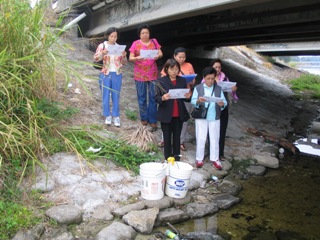
The activity is carried out in the morning at the water's edge, be it bayside or riverside. First, the entourage will stop at a pre-determined fish bait shop in the vicinity of the chosen location. Using the donations received from fellow adherents, we will buy bucketful of juvenile fish, shrimps, and sometimes, crabs, all live ones (I always tag along as I'm the designated driver since my Minivan can seat 8 passengers, and also the photographer, armed with my Canon Powershot A35).

Now, a site reconnaissance is first conducted to ascertain that the proposed site is accessible, that there is a fish bait shop nearby and it opens for business early in the morning, and that the place is not frequented by either fishing enthusiasts or preying birds for obvious reasons.

Not obvious? Then for one thing, fishing enthusiasts have a nose for where fishes congregate and where fishes are found aplenty, the juveniles that we release would have vanished instantly into the food chain, thereby defeating the purpose of our efforts. While some may view this as a symbolic act, due diligence must be exercised that their chances for survival are maximized. As for the preying birds, we usually have a trick up our sleeve, by feeding bread crumbs to them first, which in itself is a meritorious deed as well. Having their appetites satiated, the birds are less likely to swoop down on the temporarily disoriented juveniles, which can be traumatized during the release operation.

One of the adherents always provides the pails and portable aerators for keeping the juveniles alive during the short transit to the chosen location. Once at the chosen location, the ritual starts with the chanting of the Great Compassion Mantra and the Heart Sutra. Then the juveniles are released when the contents of the pails are poured gently into the water.

Today is the first time we have the ritual at the river side, actually is more like a canal, the Tampa Bypass Canal, which shunts the river discharge from the upstream of the Hillsborough River directly into the Bay during high rainfall events. But we added a new life to be released: earthworms, which are bought at the same bait shop, four cans-ful of them. But instead of pouring the can contents into the water, they are poured into shallow holes dug near the river bank then backfilled where they can then burrow to their heart's content without having to worry about wandering birds/chicken.

We left the house at 7.15am and by 9.10am, the ritual of release life was over, for today. Seeing the juveniles swimming away in a carefree fashion, instead of being gobbled up as baits at the end of a fish hook, filled our hearts with compassion, and permeated our minds with wonderful thoughts of the benevolence of life.

But for today, that wonderful feeling continued. This time, at 10.30am, the destination was the first Annual Robe Offering Celebration of the Dhamma Wheel Meditation Society held at Clearwater. Laden with cooked food ranging from fried noodles, vegetable dishes, to fresh-cut fruits (my wife prepared two bowls of water melon and strawberries), we arrived at the destination at the nick of time (my fault as I was busy talking about the recently concluded US election with my front seat passenger and missed the turn into State Route 60 from the I-275 bridge crossing the Tampa Bay. So instead of going to Clearwater directly to the north, we ended up at St. Pete at the south because there is no U-turn on the I-275 bridge and we had to make a long detour to the south first).

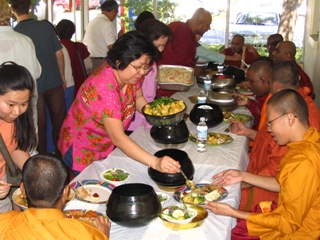
But as I said, we arrived just when the ceremony was about to start with food offering to the various Bhante (the equivalent of Venerable in Pali) monks (thirteen in all). The adherents stood on a line next to the serving table and the Bhantes then walked by in a line on the opposite side, their bowls gradually filled up by food items picked up and offered by the adherents.

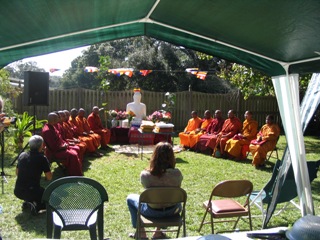
This is the most meritorious of alms giving, offering food, clothing, shelter, and robes to the sangha, any community of Buddhist monks. That done, the bhantes then sat on two opposite rows, with the apex occupied by the white statue of the Buddha, seemingly presiding over the ceremony. This was the setting for the robe offering ceremony. The adherents took turns to offer the robes stacked neatly on a table in their names as sponsors to each Bhante in turn.

This was followed by the award of certificates to newly ordained adherents, each being given a Buddhist name in Pali with the meaning explained. The ceremony concluded with a Dharma talk on the significance of the robe offering and the associated merit gathering aspect, and lastly, an acknowledgment of appreciation from the Dhamma Wheel Meditation Society (DWMS) to all concerned who had helped make this a solemn and virtuous event.

Thanks were also extended to the congregation of Unity Church, the ever helpful neighbor, for their continued support of DWMS. This inter-faith cooperation is especially credit-worthy and inspiring and should auger well for a peaceful world.

Today has indeed been a wondrous day, and we have all been blessed in more ways than one. May all beings be well, happy and peaceful, as written on the program sheet. And I extend the same to all those who visit my blog, and pray that you would likewise extend the same wish to all with whom you cross path.

P.S. I’ve been using the term "adherents" but the term used by DWMS is "practitioners". To the extent that Buddhism emphasizes the practice of the various Buddha teachings and their embracing as a way or philosophy of life, I would agree that “practitioners” would be a more appropriate and meaningful description than “adherents”, which may imply blindly following of a faith. Henceforth, I will use “practitioners”.