Showing posts with label The Buddha. Show all posts

Sunday, July 22, 2007

Life in Its Many Forms and Realms: Release, the Departed, the Buddha, and Contemplation

My wife and her Buddhist friends held a release life activity this morning next to the Veteran Memorial Park just off the bank of the Tampa Bypass Channel. This is the first time we entered the park ground as unbeknownst to us, the opening hour of the park coincided with our time of arrival, 10.00am. Before that, we stopped by a bait and tackle shop to buy juvenile fish and earthworms.

Instead of chanting the sutra at the river side, Yu Huei decided to hold the chanting session at the shop there and then on two considerations. Firstly, some of the small animals may not survive the trip from the shop to the river side. So this would ensure that they would get the good merits transferred to them while alive. Secondly, this would benefit the entire animal collection within the shop.

Indoor chanting amidst the angling gear and the entire collection of small animals.

While at the shop, a curious onlooker’s interest was piqued by the chanting. I explained to him the gist of the release life as an act of compassion toward all sentient beings. “Not pity, but compassion,” I corrected him. “God moves us in many ways,” he replied, radiating sincerity.

On the drive to the Veteran Memorial Park, I almost ran over a squirrel dashing across the road, my sudden reflexive braking motion scuttling some stuff around me. But no harm done.

At first, we were worried that the steep descent down the earth slope from the bridge to the river side may prove to be a slippery, and hence, dicey operation. But the park was just opened, and we were able to park inside the park. And the good thing is the slope to the river edge is very gentle here, at the bottom of which are scattered rock pieces to provide a firm foothold. Those must be the remnants of a rudimentary bank protection measure against erosion: rock slope. The other meritorious aspect of this particular site is the absence of preying birds that are known to swish down on the small released animals as we have learned painfully from our experience at other sites. The fish fries were released into the stream, and the earthworm, into hand-dug holes by the river side.

The outdoor release life activity, first the aquatic kind and then the burrowing kind, momentarily confined within the two brown bags in the hands of Sister Annie.

Then something else happened. A group of ducks were swaggering toward us while we were about to drive off. So the ladies alighted again, palms joined, and started chanting away at the approaching ducks, presumably sensing food from their past treatments. The merits thus transferred so that in their (the ducks') next life they would be reborn in the human realm, the realm at which Buddhahood is most reliably attained, the ladies thanked the ducks and we were soon on our way to our next destination, a Thai temple along Palm River Drive.

Transferring merits to the swaggering kind

But not before we made a slow drive around the park. It being a Veteran Memorial Park, there are many displays of war paraphernalia: helicopters, and artillery equipment. A small plot in the back was stacked full with miniature American flags, in memoriam of the many casualties of wars. The apparent irony of holding a release life activity in a park dedicated to the many soldiers perished in wars was not lost on me. But in a way, what we did could also be considered as a way of transferring merits to the departed consecrated in the park.

The Thai temple is a sprawling complex amidst the tree-lined river bank, with timber boardwalk over some of the soft ground. The temple’s inside is both regal and solemn. Next to the temple is the canteen where temple helpers were busying packing up the food orders for the expanding crowd of visitors.

Top left: A painting of a Young Buddha teaching to the Five disciples on the foreground.
Top Right: A view of the temple from the river bank.
Bottom right: the Buddha statue inside the Temple.
Bottom left: A view of the river bank from the front of the Temple.


We did the same and adjourned to one of the many tables dotting the river bank to partake of the food offering. A point to note is that the food served is a mix of vegetarian and non-vegetarian, a departure from the norm at Chinese temples where only vegetarian food is served. The rates charged for the food were very reasonable indeed and would only be possible due to the unfaltering show of volunteerism from the local Thai community, at the same time providing a steady source of revenue to maintain the temple to contribute to the well-being of all sentient beings.

A serene view from our table of feast, and contemplative too.

Sunday, December 17, 2006

Dharma Learning, Thinking, and Practicing

Today is the monthly Buddhist mantra chanting session for the Tampa Buddhist group of which my wife is a member. It is usually held at Brother Brian and Sister Connie’s house from 10.00 am to noon, followed by a vegetarian lunch. However, the group decided to have a post-lunch Dharma talk given by Brother Shieh, who came all the way from Orlando with his wife and son to share his Dharma learning with the group. I later learned that Brother Shieh was to continue his journey to Gainesville to deliver another Dharma talk in the evening, which speaks volume of his readiness to spread the Buddha teaching the best way he could. We would also soon learn that his enthusiasm for the subject matter is contagious, infusing perhaps everyone (at least from I can discern from my vantage position, being seated with my back against the wall) with a similar degree of fervor.

Our appetite satiated, the eager group gathered around Brother Shieh, who sat cross-legged comfortably and faced the group. Brother Shieh elected to adopt a bi-lingual delivery: Mandarin and English, since they are some among the group who are not well-versed in Mandarin. Also, Brother Shieh wanted to polish up his English delivery as several times in the past he has appeared before an English-speaking audience.

This is the second time I have attended a Dharma talk by Brother Shieh and this time was no difference: the same earnest self, captivating our attention with his down-to-earth explanation, practical analogies, probing questions, enthralling story telling style sprinkled with a judicious dose of humor, though he may not have realized it.

I hope I could do justice to Brother Shieh’s masterful coverage, both in depth and in breadth, spanning several aspects of the Buddha’s lessons, both from the transcription of my notes and my memory of the emphases. Any perceived inadequacy is a reflection of my limited understanding of both the Buddha teaching and scriptures, and their precepts.

While Brother Shieh’s delivery was coherent, inter-weaving a tapestry of the different lessons that comprise the Buddha teaching, here I would have to focus on the gist in point form in keeping with a blog format lest it become unwieldy.

1) All occurrences/births and terminations/deaths in earthly matters arise/depend from/on conditions. Therefore the Buddha teaches us not to be attached to the conditions, nor to the occurrences and terminations. As the 6th Chan Master, Venerable Huai Neng explained, attachment leads to affliction while detachment becomes a matter of wisdom. While affliction is often likened to wisdom, they are not the same; instead they can be viewed as two sides of our palm, which one facing up depends on our thoughts/mental response. In other words, by flipping our thoughts around, afflictions can be replaced by wisdom. For instance, we feel irritated when the air-conditioner is malfunctioning, a mental response brought about by the environment that is beyond our control. However, if we think again we would realize that it’s a temporary condition and also we could help ourselves to a cup of cold water. Then the sweltering heat would not bother us anymore.

2) Everything in life is Dharma teaching, provided we can learn from the experience and change our mental outlook for the better because of it. For example, somebody fetches us a cup of coffee and we complain that it’s too hot after taking it. So next time we would ask first, or perhaps take a very small sip first. [This reminds me of the story told by Venerable Huai Zheng during one of his Dharma lecture series on the Consciousness Only School (Wei Shi). A man always takes a particular way to work. One day while walking the same route he falls into a hole, which he has not realized before. The next day, he walks the same route again, apparently forgetting his mishap yesterday, and falls into the same route. The third day, he vaguely remembers the accident but decides to take the same way. The same result ensues. From then on he avoids the route altogether and takes a different one. So the first three occurrences are merely habitual while those after are the Dharma teaching at work.]

3) The Buddha teaching can only manifest when the inner self understands and is congruent with the teaching. This transformation presupposes that we understand our inner self and are able to change it in accordance with the Buddha teaching. This actualization requires the triple elements of learning, thinking, and practicing. Without the ability to think or not exercising our faculty to think, we cannot and would not be able to understand the Buddha teaching. And it has to be the right thinking or right view as well, one of the Eight Noble Paths and arguably the most important. A jaundiced view breeds more of the same in a vicious cycle and is the source of ignorance. On the other hand, a right view spawns new views that would lead to a purification of the mind.

4) We must especially guard against the apparent dichotomy between learning the Buddha teaching in abstract terms and when actually encountering the situation in real life that most of us tend to develop naturally. The former can misguide us into a false sense of enlightenment while we become illusionary in the face of reality. Brother Shieh always takes to heart the above tendency as a caution when conducting himself in life.

At this point I think I’ve reached the right length for a blog stuffed with enough food for thought for several nights. As Brother Shieh has expounded, we have to think for ourselves and reflect on the happenings so that we could draw Buddha lessons from each of them. Each of us has been able to accomplish what we set out to do primarily because we do not have second thoughts about it. The same applies to learning the Buddha way. We must place Dharma learning as a priority.

Stay tuned for the next installment of what Brother Shieh has imparted as I see it.

Sunday, November 19, 2006

Wonders of the World: The Old, The New, and The Vote

I wonder how many of the Seven Wonders of the World (the ancient one that is) we can recall. For me, only two: The Pyramids of Egypt and the Hanging Gardens of Babylon. Lest you launch yourself into a futile memory scouring operation, here are the remaining five, courtesy of the news story entitled “List down to 21 Candidates to be New World Wonders” in today’s issue of Tampa Tribune (pg. 4 of the Travel section):

The Statue of Zeus at Olympia
The Temple of Artemis at Ephesus
The Mausoleum of Halicarnassus
The Colossus of Rhodes
The Pharoh lighthouse off Alexandria.

Only the Pyramids survive today. Now there is a global effort to name the Seven Wonders of the present-day at the New 7 Wonders website. However, if you wish to nominate your dream wonders for consideration, you are out of luck, or rather too late, for the list has been pared down to the final 21 as displayed on the site.

On the other hand, you still have a say as to what the final Magnificent Seven would be, by popular vote. And everyone has a right to exercise his/her voting right in this only trans-boundary democratic election. The result will be announced on, when else, the only triple sevens of this millennium: 7.7.2007.

So browse through the individual description of each of the 21 candidates already prepared for you, complete with a brief history, its significance, and a two-word symbolism, and take your pick. Better still, visit the sites to gain a first-hand account if you have the wherewithal in order to make an informed decision.

Here I’ve taken the liberty to list, in alphabetical order (as is done at the site), the 21 candidate sites, just to whet your appetite:

  • The Acropolis of Athens (450 - 330 B.C.), Athens, Greece (Civilization and Democracy)

  • Alhambra (12th century) Granada, Spain (Dignity and Dialog)

  • Angkor (12th century) Cambodia (Beauty and Sanctity)

  • The Pyramid at Chichén Itzá (before 800 A.D.) Yucatan Peninsula, Mexico (Worship and Knowledge)

  • Christ Redeemer (1931) Rio de Janeiro, Brazil (Welcoming and Openness)

  • The Roman Colosseum (70 - 82 A.D.) Rome, Italy (Joy and Suffering)

  • Statues of Easter Island (10th - 16th Century) Easter Island, Chile (Mystery and Awe)

  • The Eiffel Tower (1887 - 89) Paris, France (Challenge and Progress)

  • The Great Wall of China (220 B.C and 1368 - 1644 A.D.) China (Perseverance and Persistence)

  • The Hagia Sophia (532 - 537 A.D.) Istanbul, Turkey (Faith and Respect)

  • The Kiyomizu Temple (749 - 1855) Kyoto, Japan (Clarity and Serenity)

  • he Kremlin and Red Square (1156 - 1850) Moscow, Russia (Fortitude and Symbolism)

  • Machu Picchu (1460-1470), Peru (Community and Dedication)

  • Neuschwanstein Castle (1869 -1884) Schwangau, Germany (Fantasy and Imagination)

  • Petra (9 B.C. - 40 A.D.), Jordan (Engineering and Protection)

  • The Pyramids of Giza (2600 - 2500 B.C), Egypt (Immortality and Eternity)

  • The Statue of Liberty (1886) New York City, U.S.A. (Generosity and Hope)

  • Stonehenge (3000 B.C. - 1600 B.C.) Amesbury, United Kingdom (Intrigue and Endurance)

  • Sydney Opera House (1954 - 73) Sydney, Australia (Abstraction and Creativity)

  • The Taj Mahal (1630 A.D.) Agra, India (Love and Passion)

  • Timbuktu (12th century) Mali (Intellect and Mysticism)

At a glance, you will note that each of the five inhabited continents is represented, from the oldest (3000 B.C. – 1600 B.C.) to the youngest (1954 – 73). Some have religious connotations, one of which is a Buddhist Temple (the Kiyomizu Temple, or the Clear Water Temple).

At the risk of being seen as biased, I think the Kiyomizu Temple will be one of my choices. And its two-word symbolism is most appropriate indeed, both clarity and serenity being the necessary ingredients for enlightenment on the path to Buddhahood.

The remaining six will be picked on the basis of at least one from each continent as in my book, no continent/country has monopoly over earthly wonders. But that's me. The important thing is to exercise your voting right as every vote counts. So, let your finger do the walking but your head to do the voting.

And that is my pleasantly surprising find of the day.

Sunday, November 05, 2006

The Phases of the life of the Buddha: A 3-D Rendition


While not as many as in, say Taiwan or even Malaysia, Florida has its fair share of Buddhist temples too. However, there is one aspect that is not found in the former two localities, namely, its diversity with respect to the national affiliation. So we have here, among others, Chinese temples, Thai temples, Sri Lankan temples, and Vietnamese temples.

As ethnic Chinese, we have been frequenting Chinese temples, principally because of the language barrier. Despite the fact that Buddhism, as is the case for other religions, transcends national and language boundaries, as a practical matter there is a need to transmit the various forms of Buddhist teaching in different languages so that people from myriad background can understand and hence benefit from the teaching. While the ancient sutras are written in Pali and Sanskrit, they have been translated into many languages and the tendency is for each temple to display translated sutras and other Buddhist texts as per its national origin. Until one day, that is, when we were brought to a Vietnamese temple right across the Tampa Bay from us.

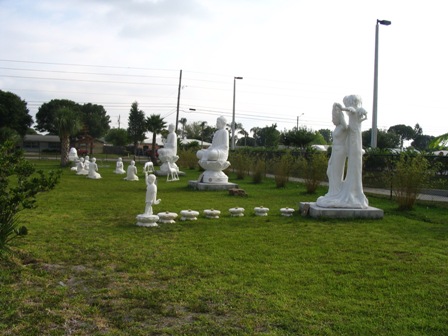
What is unique about this temple is the tapestry of white sculptures sprawling over the front lawn. Each cluster depicts a historical event in the life of Siddhārtha Gautama, the Supreme Buddha and the historical founder of Buddhism, sort of like a three-dimensional life size rendition.

The image below shows the arrangement of the three clusters of sculptures, each corresponding to an important phase of the life of the Buddha. Next, I will show a closeup of each cluster, starting chronologically from the foreground of this image accompanied by a brief account of the significance of the event depicted.


The first image shows what happened not long after the birth of Siddhārtha Gautama where he walked seven steps from his mother, Queen Maya, and declared with his hand pointing skyward, "The sky above and the groud below, I'm the only Supreme." This is my attempt at literally translating from a chinese text. However, the "I" as articulated by the Buddha is not to be construed narrowly as the first person I, but rather it refers to our original inner self. Therein lies one of the distinguishing elements of Buddhism that we are all capable of being fully awakened or enlightened, in Buddhist parlance. This is a state of complete liberation from suffering and afflictions.

The day of the Buddha's birth is widely celebrated as Vesak, not only in Buddhist countries, but also in Malaysia where Islam is the official religion but freedom of worship is guaranteed under the Constitution.


Despite being born as a prince and having lived in the palace for 29 years in comfort, Siddhārtha Gautama was troubled and left his family and possessions in search of ways to ovecome human suffering.

After trying and abandoning asceticism, he concentrated on meditation and was said to have achieved enlightenment while sitting under a Bodhi tree at the age of 35. At first, he was undecided whether to deliver the dharma (the teachings of the Buddha) as he was concerned that the many human failings (greed, hatred, and delusion) would prevent human beings from understanding the true dharma, but he was asked to teach the dharma to the world by a divine spirit.

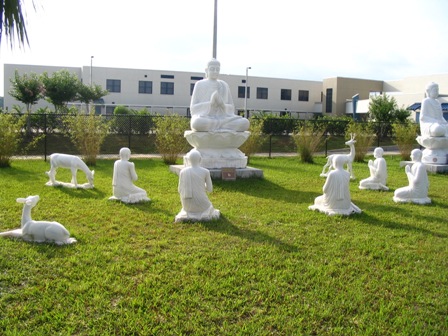
At the Deer Park in northern India, he set in motion the Wheel of Dharma by delivering his first sermon to the group of five companions with whom he had previously sought enlightenment as depicted in the second image below. They, together with the Buddha, formed the first saṅgha, the company of Buddhist monks.


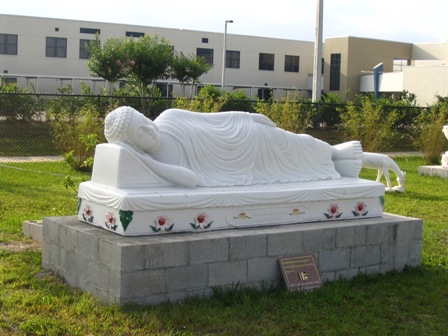
The Buddha continued his teaching of the dharma for forty nine years and entered Parinirvana, the final deathless state leaving the earthly body, in his early 80s. This great passing of the Buddha is depicted in the third image below. The final pose that the Buddha struck is reputed to be the best sleeping position to facilitate a dreamless rest when complemented by an affliction-free state of mind.


The arrangement of the various sculptures, which embody the gist of the inspiring life of the great Buddha, has left a lasting impression on me. It is also the prime motivation for me to learn more about buddhism by attending dharma talks, reading books on buddhism, and listening to tapes and audio CDs of Buddhist mantras. While I've not been ordained into Buddhism nor undergone the ritual of the five precepts like my wife has, I feel that in mind and body I'm already in the process of making the compassion, the virtue, the humility, and the giving, the core values enshrined in the Buddhist teachings, as my moral compass. Nevertheless, I look forward to the day when I will be pleasantly surprised at finally making the plunge into the embrace of Buddhism in ritual to formalize the transition.

(I would like to acknowledge that I've paraphrased some of the texts contained in several articles related to Buddhism at the Wikipedia website as referenced above and the Buddha.)

P.S. I forgot to include the name of the Vietnamese temple where the sculptures are located. Here it is.